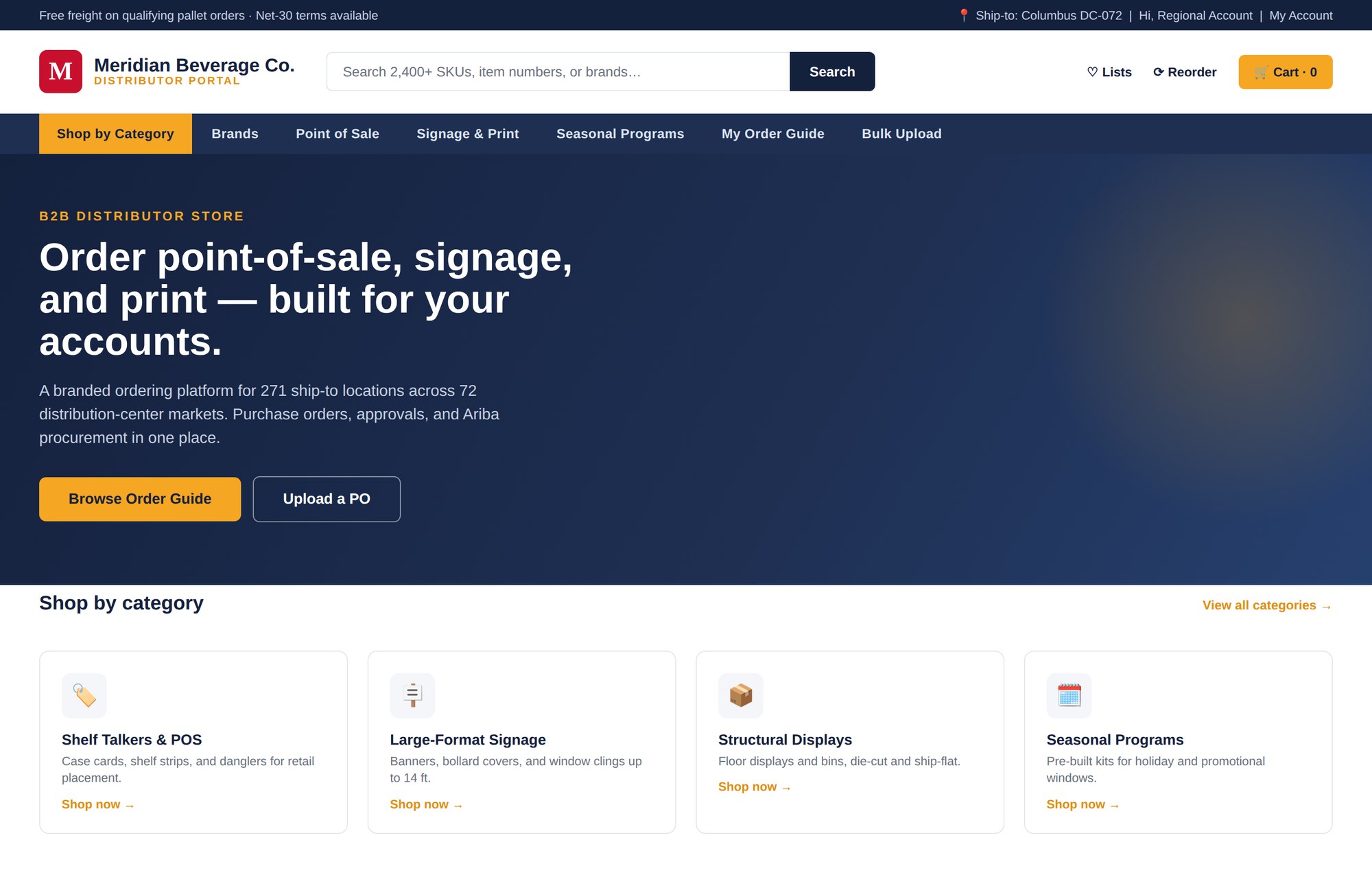
A three-year journey from the press room to platform ownership — culminating in a fully branded enterprise e-commerce store for a major national beverage distributor.
When I joined Nutis Press in January 2022 as a Prepress Graphic Designer, the company had an idea for a web-to-print platform — a self-service site where customers could customize and order printed products without a sales rep in the middle. The vision was there. The execution wasn't.
Over the next three years, I went from learning the presses in the back to owning the platform end-to-end — earning a promotion to Web Design Manager and ultimately leading the conversion of that platform into a fully branded enterprise web store for one of the company's largest clients: Meridian Beverage Co..
This case study covers the full arc: the self-directed UX audit that earned me the role, the systematic rebuild that fixed six layers of friction, and the enterprise integration that connected a small print shop's web store to a Fortune 500 procurement system.
Proofing files, learning offset and screen presses, and building the company's reusable product-template library. In the gaps, I started documenting what was broken in the web-to-print platform — work nobody asked me to do.
The self-directed audit became the case for a new role. I took ownership of the platform's UX, product data, templates, and the developer relationship — and began the systematic rebuild.
Led the conversion of the platform into a branded enterprise e-commerce store for Meridian Beverage Co., including the Punchout-to-Ariba integration. Retained post-acquisition by Vision Graphics.
Before proposing anything, I worked through the platform end to end and documented where it failed — not as a list of complaints, but as a map of where real users would drop off.
The design tool rendered colors inconsistently and accepted low-resolution uploads straight to print. If the tool can't be trusted, nothing built on it matters.
Hundreds of products with inconsistent categories and ad-hoc tags. Search and filtering ran on data that wasn't structured enough to support them.
Placeholder descriptions and missing metadata meant the platform had almost no organic discoverability.
Customers got a blank canvas when they needed guided structure — producing off-brand, unprintable results.
Drop-off between customization and order completion, driven by unnecessary fields and an unclear summary.
The platform was built for small-business owners — the wrong mental model entirely for enterprise procurement staff.
You can't fix six things at once. I sequenced the work by dependency — reliability first, because everything else is built on top of it.
Audited the editor end to end and worked with the developer to fix the color, background, and resolution defects. Until the tool was trustworthy, no other work could stick. (Detailed in the Splotchy testing case study.)
Rebuilt templates with guided, brand-safe editable zones and standardized the product data underneath them.
Implemented filtering by product type, size, and use case — essential as the template library grew past what a flat list could carry.
Wrote descriptions and applied tags and metadata across 400+ products — giving each listing a real chance at organic visibility.
Removed drop-off points between customization and order completion — fewer fields, a clearer summary, a faster confirmation.
The goal was to make customization feel effortless — not by removing capability, but by removing unnecessary decisions.
The original templates were built with maximum flexibility — a blank canvas when what customers actually needed was guided structure. I rebuilt them to limit editable zones to what genuinely needed to change: business name, contact info, a headline. Pre-set fonts and palettes kept results professional regardless of design skill, and a clear hierarchy made primary, secondary, and decorative elements obvious at a glance.
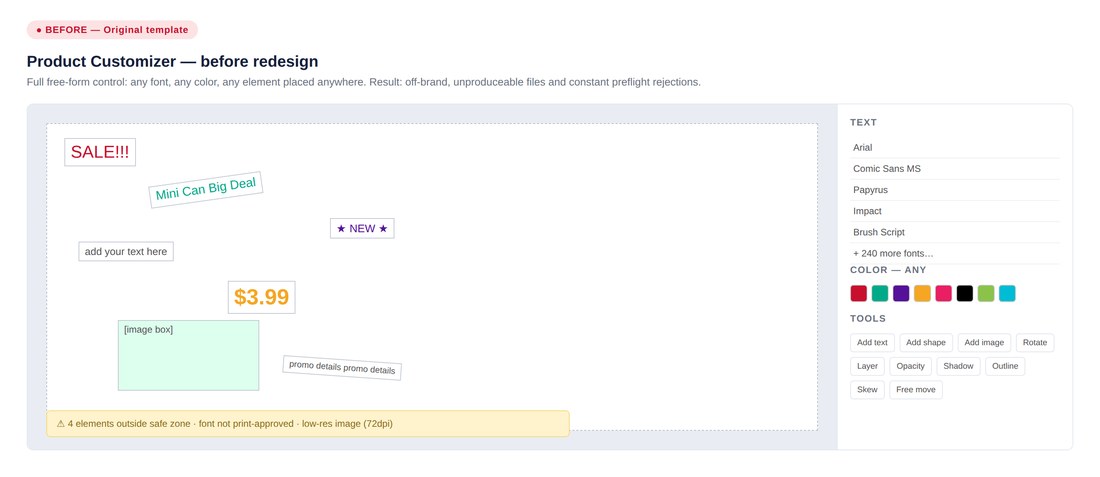
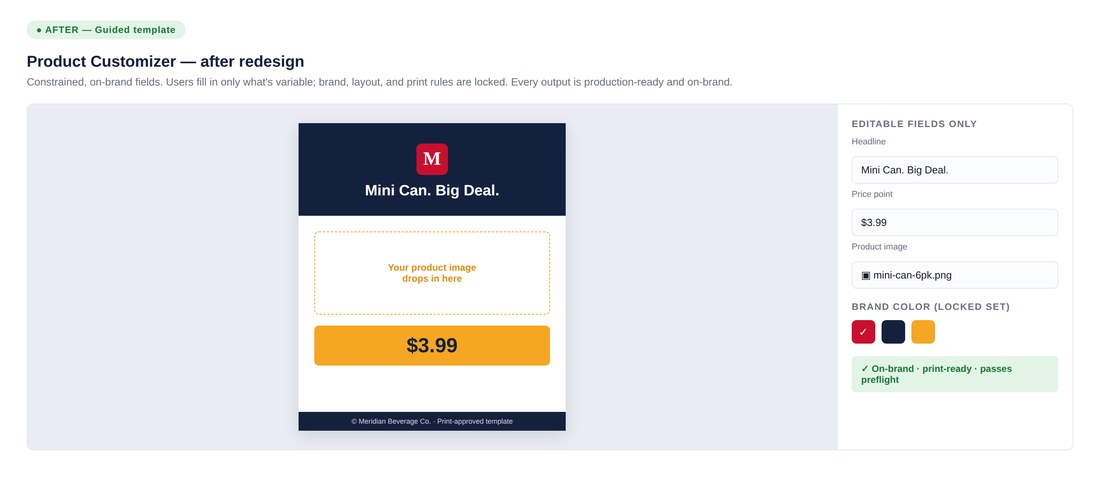
The original platform was built for small-business owners. The Meridian Beverage Co. store was built for procurement and marketing staff inside a large organization — fundamentally different users with different mental models, and that difference shaped every decision.
Budget-conscious and exploratory. They browse, compare, and want to feel like they're getting it right. They need a platform that helps them make a confident decision.
Speed- and compliance-focused. They know what they need. They want to find it, customize it within brand rules, and get it out the door without thinking about it.
I created Figma wireframes for the new structure before a line of code was written — serving as both a development spec and a tool for early conversations with the client's UX and marketing team. Reducing decisions, surfacing brand-approved defaults, and minimizing the path from login to purchase order became the design north star.
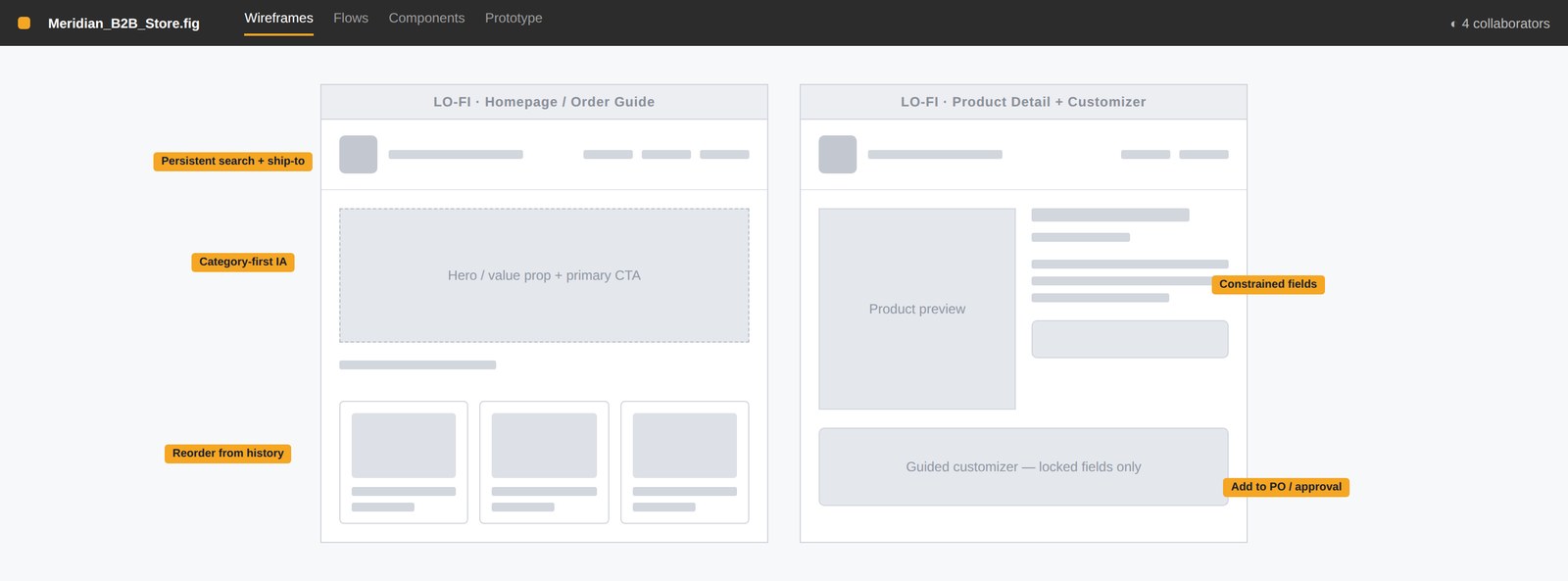
The client required all purchase orders to flow through Ariba via a Punchout integration — a protocol that lets an external web store connect to a buyer's procurement system. This was new territory. My job was to learn it, own the coordination, and keep all parties moving toward the same deadline.
The print manufacturer and platform owner. I led UX, brand compliance, template design, product setup, and coordination across all parties.
Developer responsible for the Punchout connection on the store side — limited to 10 hours a week for our account, which forced tight scoping and disciplined prioritization.
Middleware provider managing the Punchout connection between the store and Ariba — the translation layer between two very different systems and protocols.
Ariba was the procurement destination for all purchase orders. the client's IT and systems partner handled procurement-system configuration, security review, and final approvals.
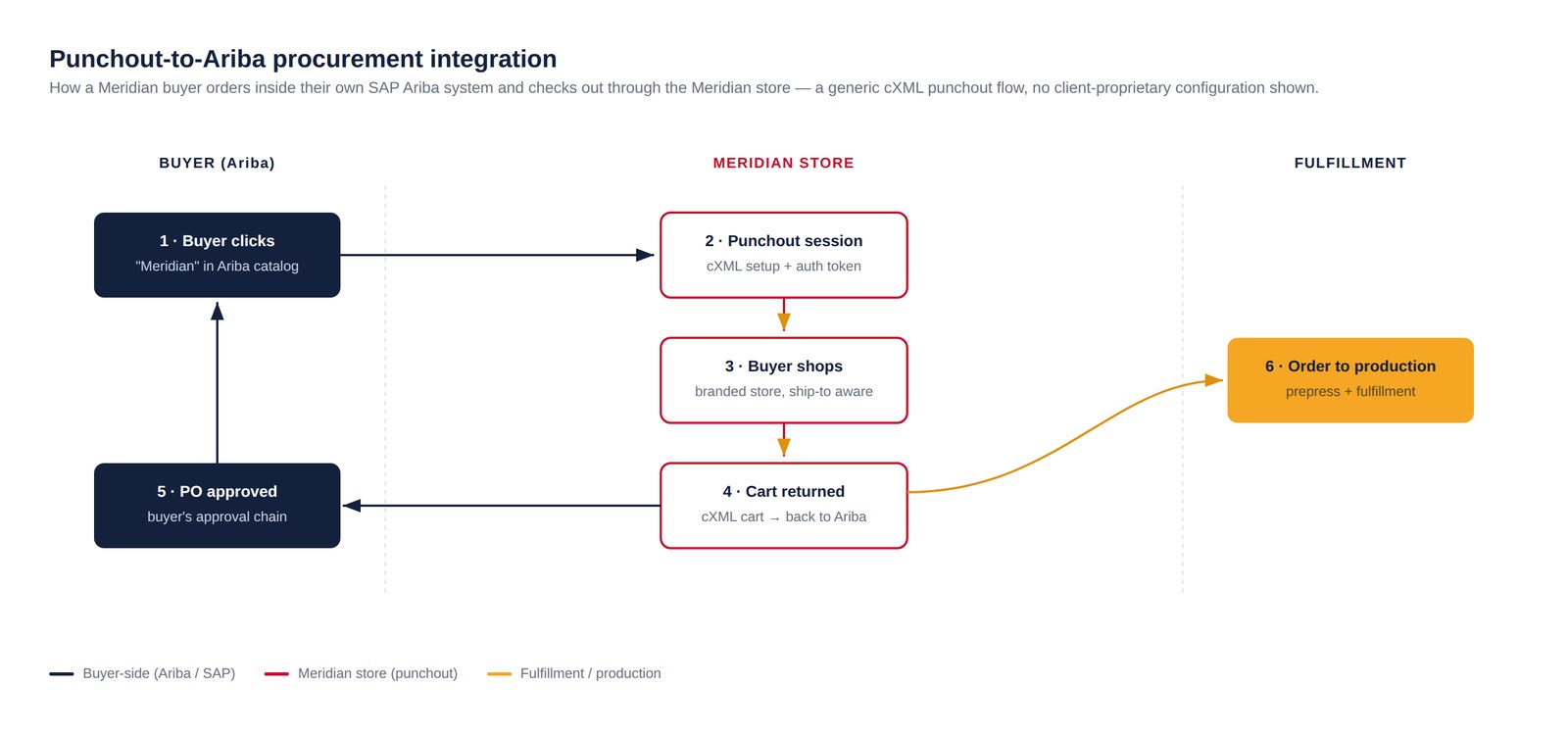
I organized and ran coordination calls across all four parties, and tested orders end to end through the integration setup phase — placing test purchase orders, confirming they translated correctly through the middleware, and verifying they landed in Ariba as expected. My job wasn't to be the most technical person in the room; it was to make sure everyone understood what the others needed, that nothing fell through the gaps, and that decisions got made rather than deferred.
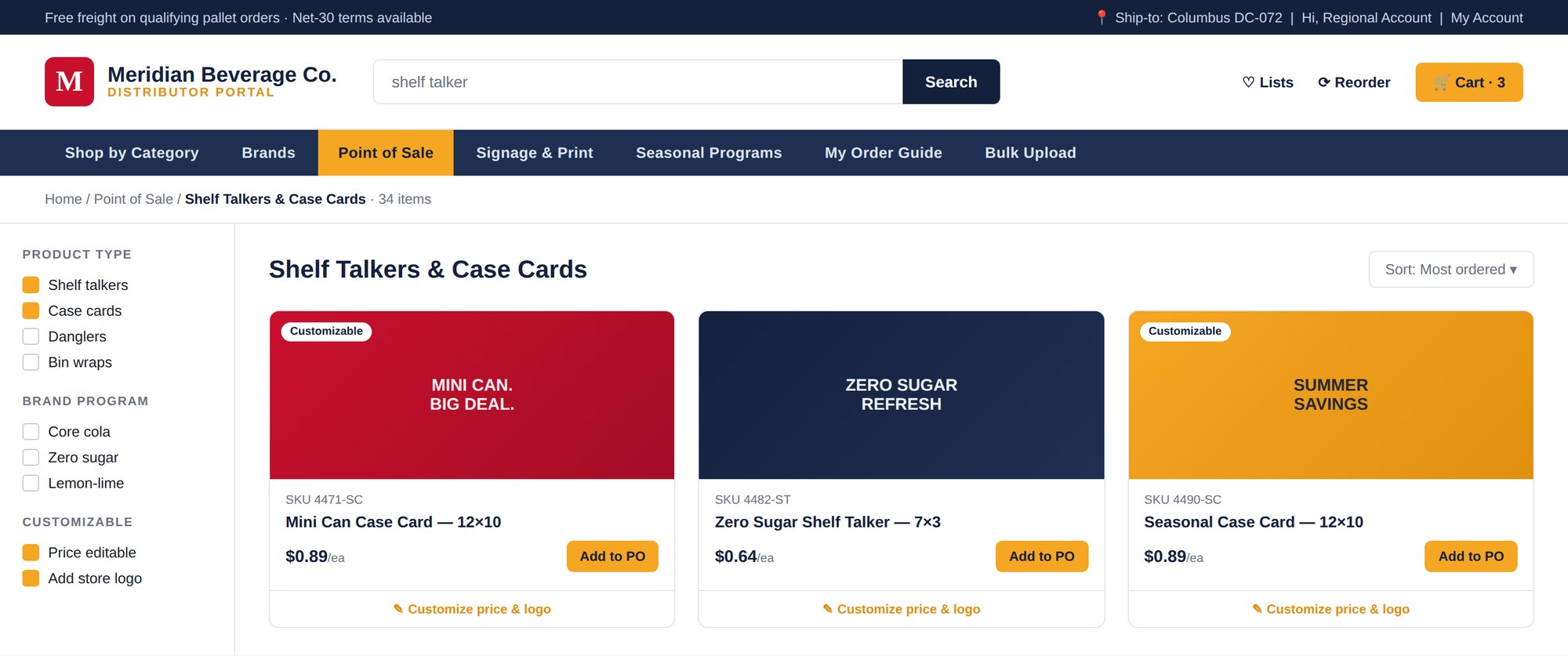
Fixing a UX problem at this scale isn't one big intervention — it's a series of small, deliberate decisions that compound. Together, they transformed a platform that existed into one that worked.
"Enterprise UX work isn't just about the interface. It's about understanding the systems — technical, organizational, and human — that the interface has to live inside."